
DLR requires wind prediction close to the ground, in sheltered areas. In contrast, wind power generation requires predicting the most likely wind speed high up in the air. Turbines are not in sheltered locations. We set out to test whether our machine has learned anything useful for wind farms.
We tested how well this wind forecast works for turbines against approximately 13,000 turbine-hours from an operational wind farm.
The model achieved a day-ahead production error of 15 - 18% NMAE at a single site (capacity-normalized mean absolute error). This is not bad for a side effect of our main solution.
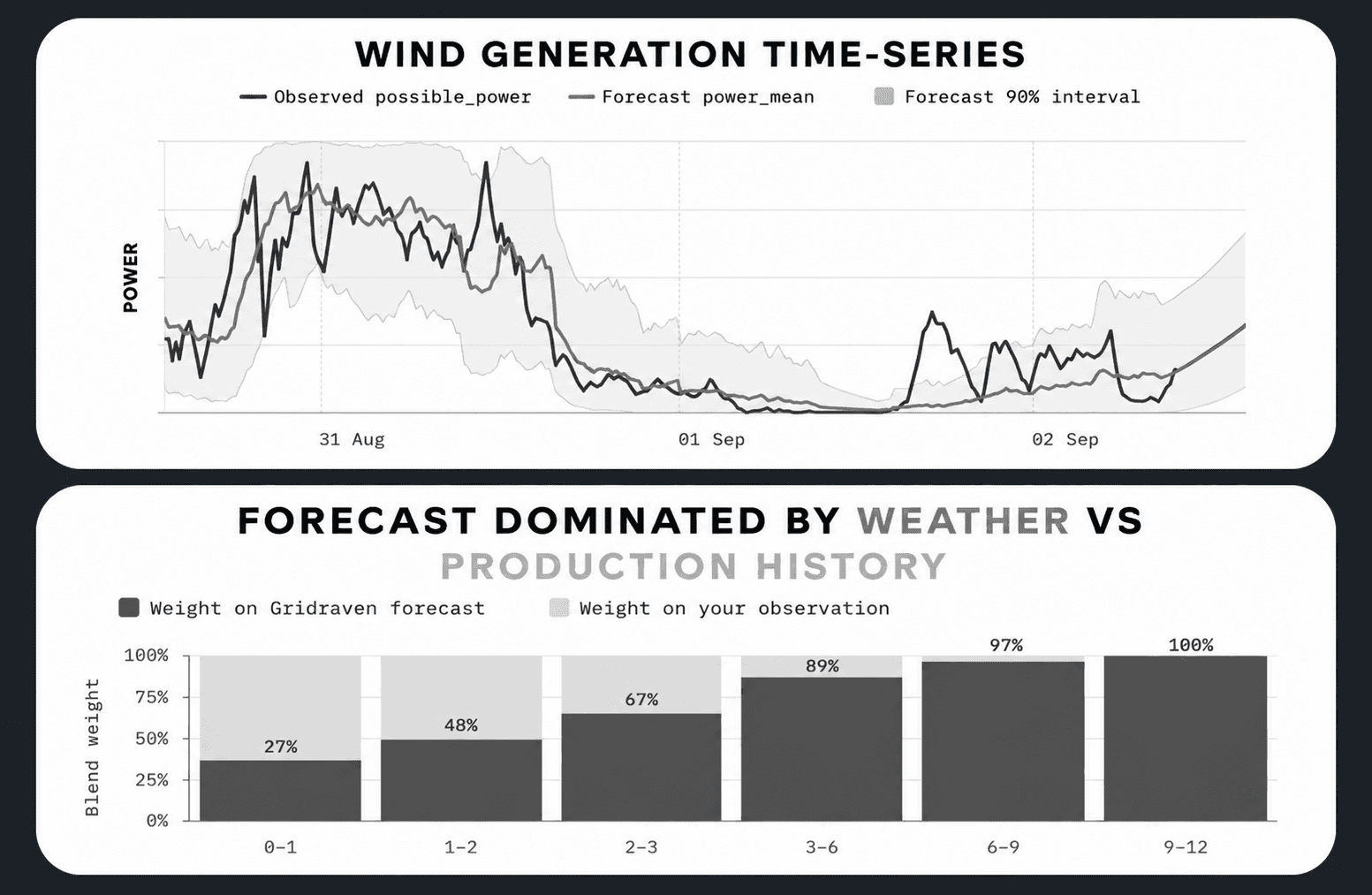
We further looked at whether we can improve on this forecast by including recent production history from the wind farm itself.
For forecasting less than an hour ahead, the model puts 83% of the weight on the farm's latest observed production data. A wind farm's output also depends wakes, curtailment and turbine control. Intra-hour, these effects dominate and the farm's latest output already includes all of these effects.
After about 90 minutes, the weather forecast takes over in importance and rises the further out one forecasts.
Generators have to submit their day-ahead production bids at a fixed time (such as 12:00 noon). Just a few hours later, a more accurate weather forecast may become available, but the bid is already locked. With a more fresh NWP, forecast errors could drop by 15 - 20%.
We have trained our ML models on 100,000+ weather stations and 1-meter resolution LIDAR data. Our machine has learned to correct for weather forecast errors for wind speed close to the ground. The fact that v0.1 does OK for turbine-height wind with almost no modifications is surprising to us. We'll continue to build v0.2.
Wind power forecasting is a busy field, but it turns out that our novel approach can have something to add. Sometimes solving one problem also solves another.